

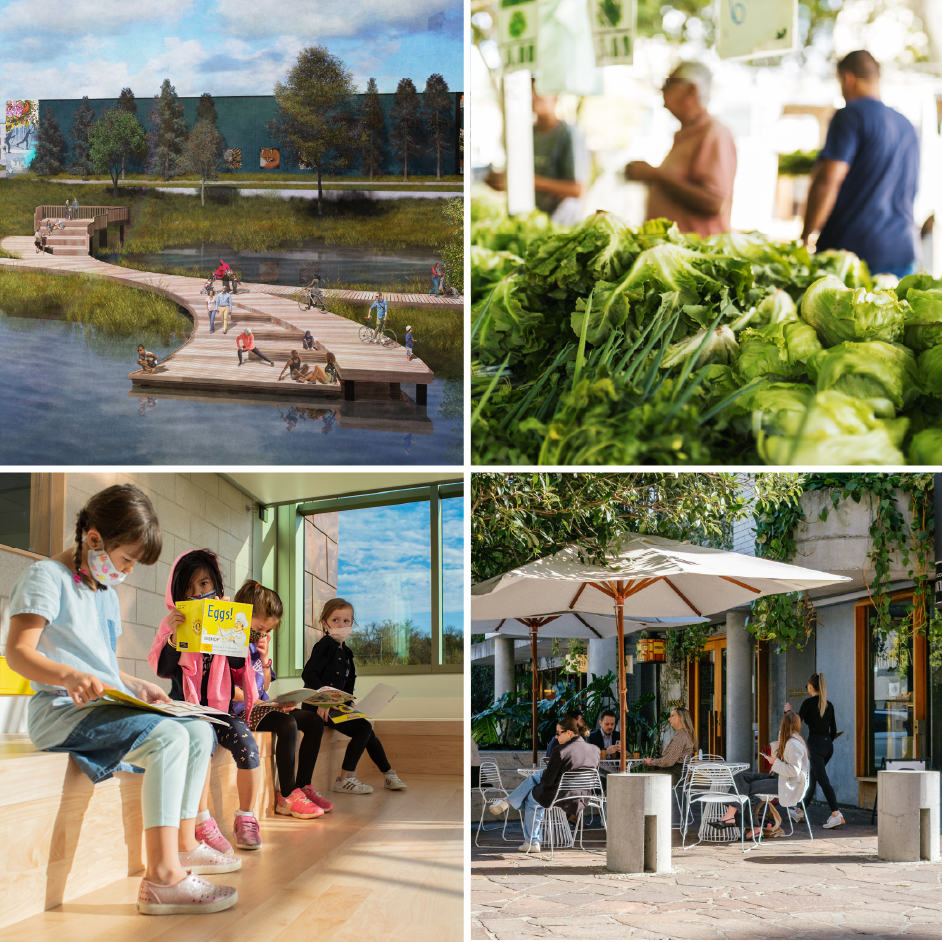

Performance matters to most of our clients. They want a building that’s healthy, durable, efficient, and maybe a source of pride for the community. But they often lack the ability to articulate their goals clearly and precisely — which is one reason they’ve sought out LHB’s design team.
To help our clients identify and describe the things that matter most to them, our designers regularly leverage Thrive, a proprietary tool, developed by our Integrative Design Team, that helps clients uncover and specify their performance goals. We use Thrive to surface clients’ objectives and build stakeholder consensus. And from those conversations, we create a customized scorecard that reflects the clients’ goals.
For the client and design team alike, the framework serves as a guide for making decisions. Unlike similar systems like LEED and Minnesota’s B3 (Buildings, Benchmarks, and Beyond) guidelines, however, the measures for success aren’t pre-determined. Our clients set the bar.
Six categories, one vocabulary
Thrive considers performance across six domains: Ecosystems, Climate, Resources, Well-Being, Community, and Prosperity. Within each of these areas are three subcategories for exploration. A questionnaire introduced at the start of the design process helps surface priority areas, but clients ultimately decide how much time and effort they want to put into the discussions around each topic.
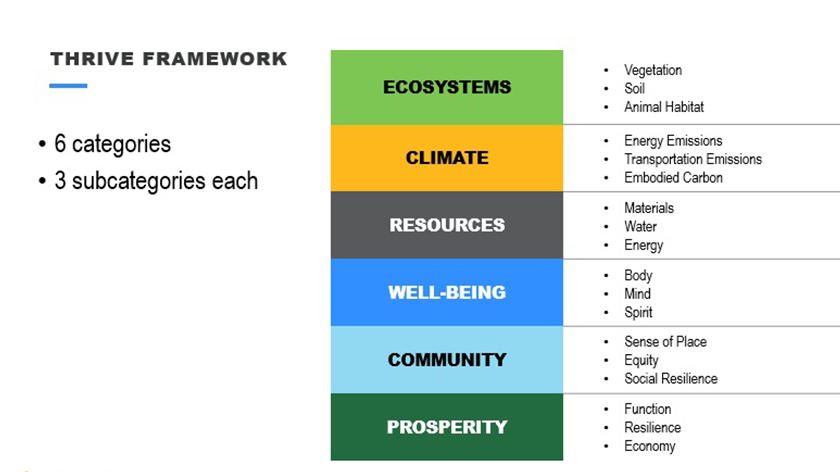
No client needs to weigh all six categories equally. Some clients care about sustainability and resilience; others may be more concerned about energy performance or occupant comfort. Thrive offers clients a way to name what matters most to them, putting their fingerprint on the project, from conception through construction.
Our team has learned that even the briefest conversations add clarity to the overall vision. A client may not cite resource use as a key area of focus, for example, but a short discussion about energy with our designers may reveal ways to reduce operational costs with an upfront investment in cutting-edge generation technologies. Many clients are surprised by the unexpected benefits that surface from the Thrive conversations.
A system that syncs with others
Thrive also gives clients a way to check design decisions against their values. What gets built is documented alongside why specific choices were made and which priorities they served.
Thrive often proves especially useful during value engineering, for example. When budget pressure forces a team to cut scope, the Thrive checklist helps highlight how eliminating an item undermines a goal that the client named as a priority. Thrive gives the team a reference point for the conversation: Rather than debating cost against quality in the abstract, the team can check a proposed change against the priorities documented at the project’s start.
Thrive was built to work alongside Minnesota’s B3 (Buildings, Benchmarks, and Beyond) guidelines, which many of LHB’s public-sector clients already follow. B3 sets the state’s baseline sustainability requirements, but Thrive adds layers focused on outcomes related to well-being, community, and prosperity that B3 doesn’t cover.
Thrive also overlaps with the Living Building Challenge’s Petal certification system, which organizes performance into similar categories. The difference is in rigor. Petal requires teams to meet audited standards within each petal to earn certification.
But Thrive differs from both B3 and LBC in allowing the client to set their own goals. Projects don’t get bogged down because they don’t meet entitlement standards set by third-party entities. There are no pre-set metrics for energy emissions or water use, so a client may choose to set a goal that is slightly less or even higher than those articulated in B3, for example. What’s more, the paperwork associated with documenting B3 or LEED criteria compliance isn’t required—even if you choose to meet those standards!
Clients are often challenged as they try to figure out what they actually want from a building. Our design team is skilled in helping articulate their goals, of course, but Thrive adds depth and dimension to the discussion. The result is a design that embodies a client’s values and priorities even as it becomes a building. ∎
Does Thrive sound like a good fit for your project? Contact Aaron Kelly to find out how to work with LHB.

