


Like many municipalities across Minnesota and the U.S., the City of Saint Paul has responded to the global climate crisis by setting ambitious sustainability goals. Its latest effort—a comprehensive plan authored by LHB for decarbonizing all city-owned buildings—marks a critical step in meeting its goal of carbon neutral building operations by 2030.
LHB’s climate-solutions team began working with the city in 2024 to establish a clear pathway to eliminate carbon pollution from its municipal buildings. The resulting Municipal Buildings Decarbonization Plan, developed with the city’s Office of Financial Services Real Estate Division and funded through the U.S. Department of Energy’s Energy Efficiency and Conservation Block Grant program, recommends leveraging efficiency, electrification, renewables, and (limited) offsets to help the city achieve its goals.
Why start with buildings?
The city’s real-estate portfolio is large and varied, encompassing 152 buildings totaling 2.4 million square feet. In 2024, energy use across these buildings amounted to 227,143 MMBtu (roughly equivalent to the annual gas usage of 3000 average homes in the U.S.).
Since 2015, Saint Paul has successfully leveraged cleaner grid electricity, facility changes, and operational efficiency gains to reduce building-related greenhouse gas outputs by nearly 46%. Nonetheless, municipal buildings remain the city’s largest operational emissions source, largely due to emissions tied to gas. In 2024, gas provided 61% of total building energy, electricity 31%, and district energy 8%.
A balanced, staged roadmap
Reducing building-related emissions is key to reaching St. Paul’s decarbonization goal. Our proposed plan focuses on ways to use less energy and switch to cleaner energy across all city-owned and operated buildings. Areas of focus include:
- Efficiency and electrification. The city should fully electrify high gas-use buildings, embed lower-carbon choices into routine equipment/system replacements, and scale strategic energy management to capture operational savings. Heat pumps which can shift heating duties from gas to electricity should become the default choice.
- On-site solar. Rooftop PV should be introduced and expanded where it delivers resilience and benefits, complementing efficiency measures.
- Off-site renewables. Renewable electricity can be used temporarily to cover the city’s remaining load until the grid is fully carbon-free. The city already participates in Xcel Energy’s Renewable*Connect program, covering 10 facilities and roughly 7% of municipal electricity—and community solar, covering about 30% of electricity across 22 facilities.
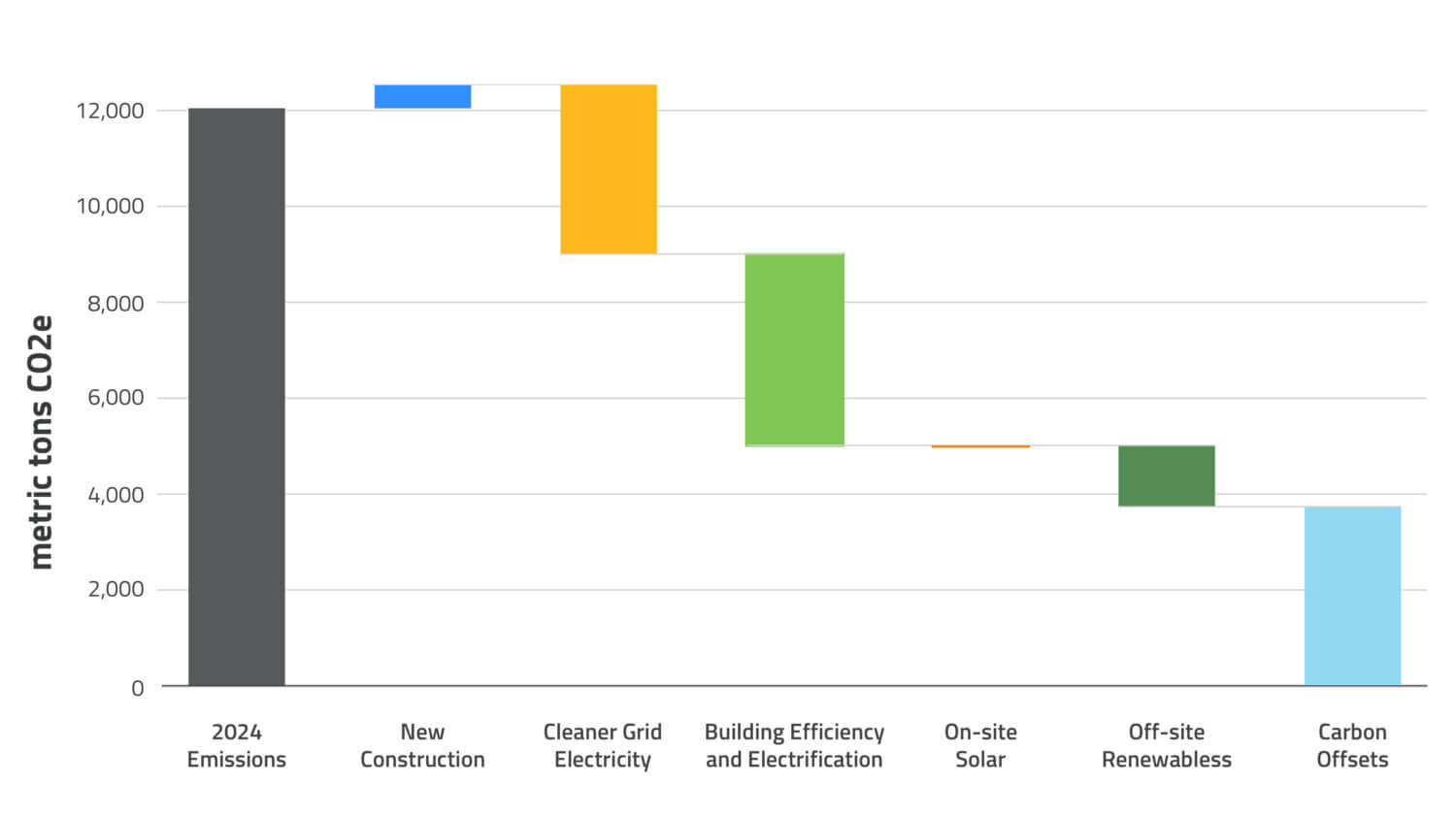
- Carbon offsets. The city should invest in high-quality offsets for residual emissions that cannot yet be eliminated on site. Purchasing off-site renewable electricity is expected to reduce 2030 emissions by roughly 14%; these purchases can be phased out once Xcel Energy, which provides power to hundreds of cities across Minnesota, including the City of Saint Paul, achieves its goal to provide 100% carbon-free electricity. (The utility is currently on track to achieve this goal by 2035.)
Target the biggest carbon producers first
Efficiency and electrification deliver the single largest slice of the emissions reduction. Together, they are expected to cut building-related emissions by 45% from the 2024 baseline after accounting for grid changes and new construction.
The plan initially focuses on the largest CO2 emitters. The city’s zoo and parks properties, for example, contribute a disproportionate share of municipal building emissions: Citywide in 2024, almost 40% of municipal building emissions came from Como Park & Zoo properties, with roughly 25% from other parks facilities. The plan recommends weaning the Como campus off gas by 2035 using geothermal and efficiency upgrades.
Phased progress into the future
LHB also recommended that new facilities should default to all-electric designs and be built “clean-energy ready,” with capacity and space for solar, EV charging, and storage to keep future retrofit costs down. Meanwhile, existing buildings follow a phased approach that balances feasibility, cost, and equity while coordinating electrical upgrades with other loads (e.g., EV charging). All designed systems should consider the future of building electrification with choices such as heating with low temperature water, utilizing energy recovery technologies whenever possible, and expanded electrical service capacity.
Many cities set community-wide climate targets; far fewer map out credible, portfolio-specific steps for their own facilities. Saint Paul’s plan does both. By sequencing investments—targeting the largest sources first, institutionalizing low-carbon replacement decisions, and using renewables and (only where needed) offsets as bridging tools—the city has put its 2030 goal within reach. ■
Curious how your community can eliminate carbon pollution from its buildings? Contact Climate Solutions studio leader Maureen Colburn or LHB engineer Alec Ashton.